


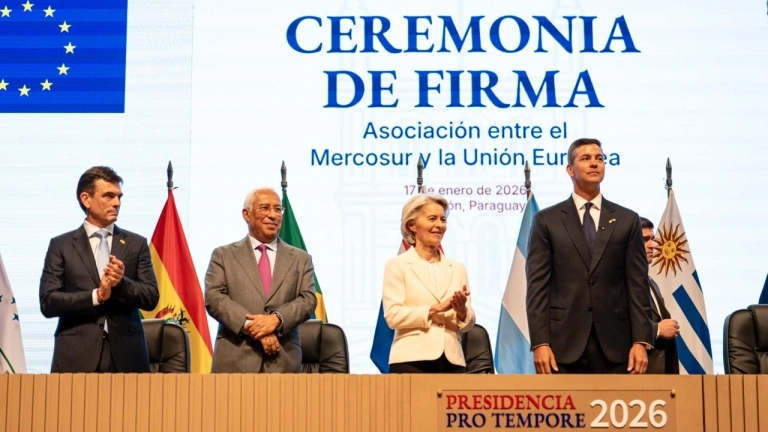
European Union and Mercosur leaders signed a long-negotiated free trade agreement in Asuncion, Paraguay on January 17, 2026, closing more than two decades of talks but still leaving a ratification process ahead in Europe and in Mercosur member states.
What the EU – Mercosur agreement actually does
At its core, the agreement aims to remove tariffs on most trade between the two blocs, with reports consistently pointing to liberalization covering more than 90% of tariff lines over time. Supporters describe it as a supply-chain and competitiveness move, especially for industrial goods from Europe and agricultural exports from South America, while opponents in parts of Europe argue it could pressure farmers and raise environmental concerns.
Just as important: the deal is not in force yet. It still needs approval through EU processes (including the European Parliament) and domestic procedures on the Mercosur side.
Is Panama included in the EU – Mercosur free trade agreement
No. The EU Council and major reporting on the signature describe the counterparties as the Mercosur member countries Argentina, Brazil, Paraguay, and Uruguay. Panama is mentioned in coverage as a Mercosur associate presence around the event, not as a party to the EU – Mercosur trade deal.
So why does Panama show up in the story
Because Panama became a Mercosur Associate State on December 6, 2024, with the status formalized at a Mercosur summit attended by Panama’s president. This matters for regional positioning, but it is different from full membership.
Mercosur itself describes its network of agreements with other countries and groups, including Associated States, as part of how it builds broader economic ties beyond its full members.
How Panama can benefit anyway (without being in the EU – Mercosur FTA)
Panama’s opportunity is mostly indirect, plus whatever Panama negotiates separately through its own trade instruments with Mercosur.
1) Logistics and re-export services could get more valuable
If EU – Mercosur trade volumes expand after ratification, companies will look for efficient routing, warehousing, and distribution options. Panama’s platform strengths (Canal-adjacent maritime services, ports, air connectivity, and free-zone style operations) can position it as a services hub for moving goods, managing inventory, and handling compliance and documentation for the region. This is an opportunity for operators in logistics, cold chain, customs brokerage, and supply-chain tech, not an automatic tariff benefit.
2) More demand for regional headquarters and professional services
A bigger, rules-based trade lane between Europe and South America can increase the need for legal, tax, finance, insurance, and arbitration services that support cross-border operations. Panama can compete for that activity by marketing its connectivity and services ecosystem, especially for firms that want a stable base between markets.
3) Panama can pursue targeted trade gains through its Mercosur track
Panama’s government has framed its Mercosur association as a way to open commercial opportunities, and Panama has also referenced an economic complementarity approach with the bloc (including ACE No. 76) to expand cooperation and market access without requiring Panama to join Mercosur’s common external tariff structure.
The practical upside is that Panama can negotiate sector-by-sector advantages and cooperation measures with Mercosur partners, even while the EU – Mercosur deal runs on a separate track.
A quick local lens for residents and expats
If Panama leans into this moment, the most visible on-the-ground effects are likely to show up first where international business activity concentrates, such as Costa del Este and parts of Panama City that host multinational teams and service providers.
Separately, internationally connected communities like Boquete can benefit from second-order effects like more specialized services, stronger small-business demand, and broader professional mobility, even if the trade agreement itself does not change local tariffs overnight.
Bottom line
Panama is not a signatory to the EU – Mercosur free trade agreement. The near-term upside is less about tariff cuts and more about Panama positioning itself as the place where trade gets financed, routed, warehoused, insured, and managed, while using its Mercosur associate channel to negotiate practical, targeted advantages over time.
If you’d like, Casa Solution can help you evaluate where to base yourself in Panama, connect you with trusted local professionals, and plan a smart on-the-ground setup that matches your lifestyle and business goals.
Date written: January 18, 2026