


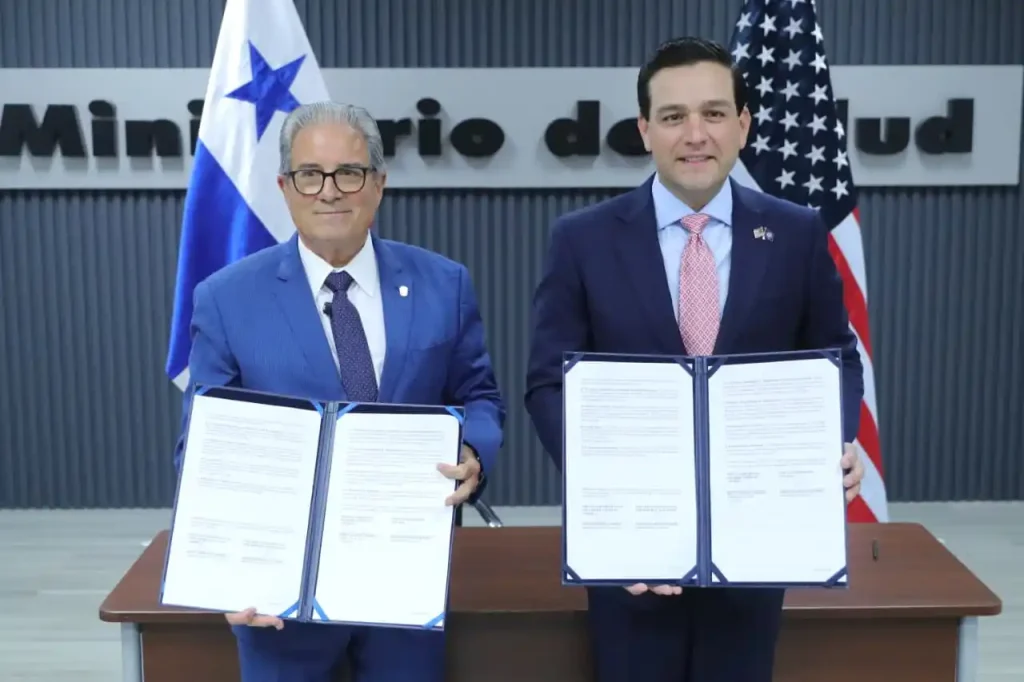
Panama and United States Sign Landmark Global Health Agreement
Panama has become the first country in the hemisphere to sign a bilateral Memorandum of Understanding on global health with the United States, formalizing a three-year cooperation framework focused on disease prevention, HIV response, and public health modernization.
The agreement was signed by Health Minister Dr. Fernando Boyd Galindo on behalf of Panama’s Ministry of Health and by U.S. Ambassador Kevin Marino Cabrera representing the United States government. The announcement was made on February 25, according to official communications from Panama’s Ministry of Health and the U.S. Department of State
$22.5 Million in U.S. Support and Expanded National Investment
Under the agreement, Panama will receive up to $22.5 million over the next three years to strengthen efforts in the fight against HIV/AIDS and improve disease surveillance systems nationwide. At the same time, Panama has committed to increasing its own national health spending by more than $11 million, reinforcing a shared financial responsibility model.
The cooperation is framed within the U.S. President’s Emergency Plan for AIDS Relief – PEPFAR – and is described as one of the first bilateral agreements of its kind in Central America focused on preventing outbreaks and strengthening long-term disease response capacity.
This structure reflects a partnership approach rather than one-sided assistance. Both governments are committing resources, signaling alignment on public health priorities and long-term institutional strengthening.
Digital Modernization and Rural Access
A central innovation within the agreement is Panama’s expansion of decentralized primary care services, particularly in rural and hard-to-reach areas. Community health workers will be equipped with digital tools to register patient data in electronic medical records, allowing real-time disease reporting.
According to official statements, the system will also enable immediate sharing of laboratory results, improving patient follow-up for HIV and other infectious and chronic diseases. This integration of digital health infrastructure strengthens early detection capabilities and enhances response times during potential outbreaks.
From a bilateral perspective, the adoption of shared standards and digital interoperability enhances transparency and coordination between institutions in both countries.
A Strategic Deepening of U.S.-Panama Relations
Beyond the health sector, the agreement carries broader diplomatic significance. By becoming the first country in the hemisphere to formalize this type of bilateral global health MOU, Panama positions itself as a regional partner aligned with U.S. public health strategy and international health governance standards.
Health cooperation has historically served as a stabilizing pillar in diplomatic relations. Structured, multi-year agreements such as this one provide continuity beyond political cycles and create long-term institutional ties between ministries, agencies, and technical teams in both countries.
The shared funding commitment also reflects mutual confidence. The United States is directing targeted financial resources to Panama, while Panama is increasing domestic investment rather than relying solely on external support. That balance strengthens the credibility of the partnership.
Regional Implications
The agreement may also set a precedent for similar frameworks in other Central American nations. With Panama serving as the first signatory in the hemisphere, it becomes a reference point for future regional health collaborations under U.S. strategy.
In a global environment where public health preparedness, digital health infrastructure, and outbreak response are increasingly linked to economic stability and national security, bilateral agreements of this nature carry significance well beyond the healthcare system.
By formalizing cooperation in disease surveillance, HIV prevention, and rural health delivery, Panama and the United States are reinforcing a structured and strategic relationship grounded in shared institutional goals.
Date: March 1, 2026