

Panama’s Panama-David-Frontera railway project entered a more technical phase in early 2026. In January, the Cabinet approved Resolution No. 145-25 authorizing a B/.4,170,394.73 contract with AECOM Panama for technical and strategic advisory services tied to the project’s next stage. The work includes advancing 20% engineering for the Albrook-Sajalices segment and consolidating the studies needed for the project’s formal feasibility document.
That means the train is still not in the construction phase, but it is moving through the kind of engineering, financial, environmental, and planning work that large infrastructure projects typically require before breaking ground. According to Panama’s Presidency, the railway secretariat has already advanced the master plan, defined the scope of Phase 1, and moved ahead with key studies including the environmental impact assessment, target population studies, market analysis, and financial, economic, and social evaluations.
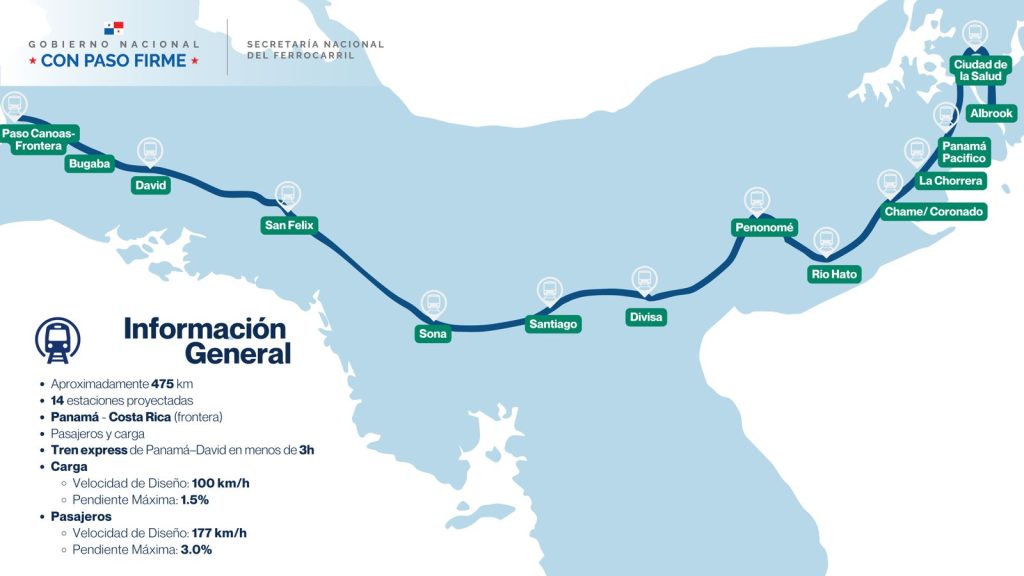
The route itself is more clearly defined than before. In May 2025, President Jose Raul Mulino announced a 475-kilometer corridor with 14 stations: Ciudad de la Salud, Albrook, Panama Pacifico, La Chorrera, Chame-Coronado, Rio Hato, Penonome, Divisa, Santiago, Sona, San Felix, David, Bugaba, and Paso Canoas-Frontera. The government has also said the passenger service is being designed for speeds of up to 180 km/h, while freight service could reach 100 km/h. The stated goal is an express trip from Panama City to David in about three hours or less.
One of the most important 2026 updates is that the project scope has widened. Beyond the Albrook-Sajalices segment, the government said it requested additional 20% engineering between Albrook and El Espino, plus a 20% conceptual design for a fifth bridge over the Panama Canal. That bridge is considered a strategic piece of infrastructure because it would help maintain rail continuity across one of the country’s most sensitive logistics corridors.
The latest official update also points to what comes next. Authorities say the project now needs an integrated consultancy process that can coordinate all feasibility studies under the Ministry of Economy and Finance methodology. AECOM’s January 2026 assignment also includes support on geotechnical follow-up, environmental oversight, business-plan components, legal and regulatory review, and an early assessment of transit-oriented development potential in six key points along the corridor. In parallel, Panama also held talks with the United Kingdom and UK Export Finance in 2025 about possible study-stage and construction-stage financing support.
There is also a workforce angle beginning to emerge. The railway secretariat has publicly invited professionals to submit resumes to support the project, particularly in technical, administrative, and engineering areas. The invitation has been promoted through official and related social media channels, although detailed job categories and hiring volumes have not yet been publicly outlined in the official Presidency articles reviewed.
How this could affect property markets
For real estate, the biggest implication is not immediate price movement, but improved long-term visibility around future transport nodes. Areas linked to planned stations such as Albrook, La Chorrera, Coronado, Penonome, David, Bugaba, and Paso Canoas may gradually attract more investor attention as planning becomes more concrete. At this stage, though, the project is still in study and engineering mode, so any real estate decisions should be based on current market fundamentals rather than speculation alone. Community links sourced from Casa Solution’s site map.
For buyers, expats, and investors, the practical takeaway is simple: the train is still a medium-to-long term infrastructure story, but the 2026 update shows that Panama is continuing to organize the technical groundwork rather than letting the idea sit idle. That matters because major transport projects tend to influence logistics, commuting patterns, commercial demand, and land use over time, especially near confirmed station areas.
If you are evaluating property in communities that could benefit from future rail connectivity, Casa Solution can help you compare today’s market reality with the longer-term infrastructure outlook.
Date written: March 8, 2026