

A New Proposal Beneath the Canal
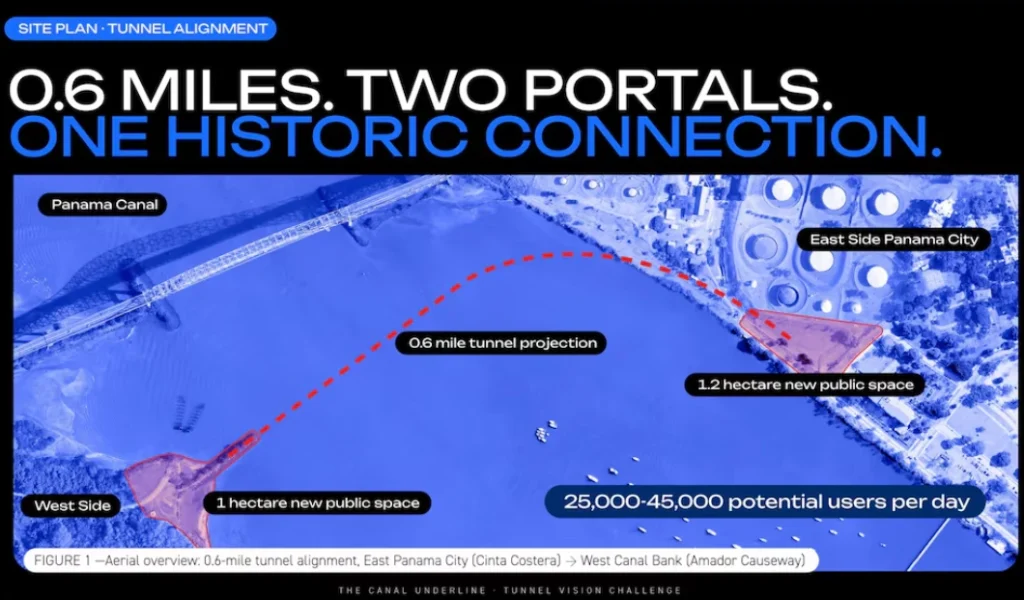
Panama City’s proposed “Canal Underline” has gained attention after advancing to the next phase of The Boring Company’s international challenge. The concept, presented by the mayor’s office, envisions a pedestrian and cycling tunnel beneath the Panama Canal that would combine mobility, public space, history, and tourism. It has also drawn notice for being the only non-U.S. proposal publicly highlighted at this stage.
That visibility gives the project momentum. Still, attention alone does not guarantee long-term value as a visitor attraction.
The Key Question – Would Tourists Actually Visit?
The central issue is not whether the idea sounds innovative. It does. The real issue is whether travelers would actually go out of their way to experience it. That is where a more skeptical view begins to make sense.
From an engineering and branding standpoint, a tunnel under the Canal is easy to market. It sounds modern, ambitious, and internationally relevant. But tourism is rarely built on engineering alone. Most visitors do not choose a destination simply because it has a tunnel. They travel for scenery, culture, local identity, food, history, and experiences that feel memorable enough to share and repeat.
A Strong Headline – But Is It a Real Experience?
That creates an important challenge for this proposal. Walking or biking through an enclosed passage under one of the world’s most famous waterways may sound impressive in theory, but the actual visitor experience could feel less dramatic than the headline suggests. Unless the space is designed in a highly immersive way, the result may be more symbolic than unforgettable.
That appears to be the weak point in the current public pitch. The tunnel has been described as more than a mobility solution, with references to historical interpretation and museum-style elements. That would certainly improve the concept. Even so, there is a difference between a well-designed civic project and a true destination driver. If the final takeaway is simply that visitors crossed beneath the Canal through a clean, well-built tunnel, the experience may end up feeling more novel than essential.
The Engineering Reality
There is also the issue of scale and cost. Panama already has a major underground project beneath the Canal through Metro Line 3, which has demonstrated that sub-canal construction is possible. At the same time, that project also highlights how technically demanding and expensive this type of infrastructure can be. Building under the Canal is not a simple tourism add-on. It is serious infrastructure with serious planning requirements.
Tourism Works Best Above Ground
That is why the broader tourism strategy matters. If Panama wants to increase visitor spending, improve the city’s appeal, and create experiences with stronger emotional impact, cultural and adventure-based investments may offer wider returns. Canal-related tourism already exists, but many travelers stay longer and spend more when the experience expands into heritage districts, food, public events, waterfront activity, nightlife, nature, and places with strong local character.
This is already visible in areas such as Panama City and Casco Viejo, where walkability, architecture, history, and urban energy create a more layered visitor experience. Investments that strengthen those kinds of environments often generate broader benefits for tourism, residents, and real estate interest alike.
A Supporting Attraction – Not the Main Event
This does not mean the tunnel is a bad idea. It means the project may be better positioned as a supporting attraction rather than the centerpiece of a tourism strategy. If built, it would likely need outstanding design, storytelling, visual elements, and strong integration with surrounding public spaces to become more than a one-time curiosity.
Suggestions such as a zipline across the Canal or other adrenaline-driven concepts may sound more exciting on the surface, but they are not realistic within one of the world’s most strategic and tightly controlled maritime corridors. A more practical direction would be to develop canal-adjacent cultural, entertainment, and outdoor experiences that feel distinctive without conflicting with the Canal’s operational importance.
The Bigger Takeaway
The larger takeaway is straightforward. Innovation can add value, but memorable tourism usually comes from experiences people can feel, see, and connect with emotionally. A tunnel under the Canal may support that goal. On its own, it may not be enough to define it.
For buyers, investors, and expats following how infrastructure and tourism projects shape lifestyle appeal in Panama, Casa Solution can help explore opportunities in established communities and emerging areas across the country.
Date written: March 8, 2026