


Panama Housing Market Shows Two Speeds – Strong Demand at the Base, Pressure at the Top
Panama’s residential market is moving in two different directions depending on the segment. While expats continue to drive demand in coastal and lifestyle destinations, new data shows that the working-class housing segment in major urban areas is facing a significant slowdown, even as policymakers aim for a recovery in 2026.
A Sharp Contraction in Affordable Housing Supply
According to Convivienda, Panama’s residential construction sector experienced a cumulative 55% contraction across 2024 and 2025, with nearly 10,146 fewer housing units delivered compared to previous cycles. In 2025 alone, the drop reached close to 30%, or 4,020 units, highlighting a meaningful slowdown in new housing supply.
Despite this, the industry is targeting a 38% rebound in 2026, with projected sales of 5,530 units. However, industry leaders caution that reaching this goal will require coordination between government institutions and the banking sector.
The data also reveals where demand remains strongest. The majority of transactions in 2025 occurred in the $40,000 to $60,000 range, reinforcing that the working class continues to rely heavily on entry-level housing options. In fact, 81% of all sales under $120,000 fall within the Preferential Interest program, showing how dependent this segment is on financing incentives.
Housing as an Economic Multiplier
Beyond housing itself, the sector plays a broader role in Panama’s economy. Convivienda estimates that for every $1 not invested in construction, the economy loses approximately $2.35 in economic activity. This reflects the interconnected nature of the industry, from materials and labor to logistics and services.
Currently, more than 150,000 jobs depend directly on construction, meaning that a slowdown has real consequences. Reports indicate that reduced activity is pushing workers toward informal employment or lower-paying sectors such as agriculture, where average monthly income can drop to around $300.
Tax Policy and Its Impact on Accessibility
One of the most debated issues is the application of a 2% property transfer tax (ITBI) on primary residences. According to the study, this measure may have unintended consequences.
While the tax could generate approximately $37 million in revenue, the broader economic impact suggests losses of up to $131.5 million in other tax categories, including ITBMS and income tax. This results in a net fiscal loss of $94.5 million and a reduction of approximately $1.28 billion in economic activity, equivalent to 1.6% of Panama’s GDP in 2025.
More importantly, the burden falls disproportionately on lower-income buyers, limiting access to homeownership and slowing down the segment that represents the majority of real demand.
A Split Market – Urban vs Lifestyle Regions
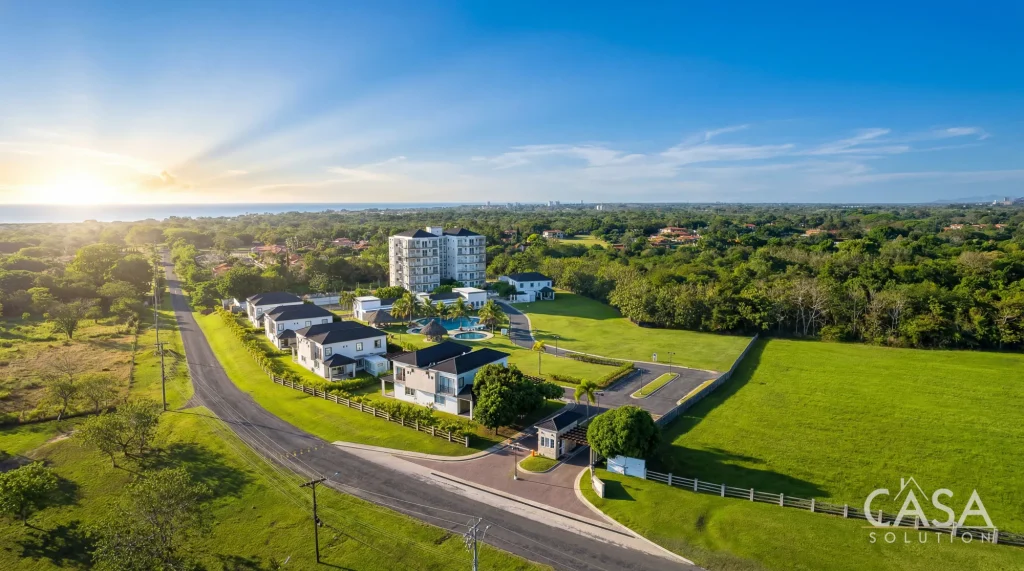
This trend contrasts with what is happening in lifestyle-driven markets across the country. Areas such as the and continue to attract expat buyers and second-home investors, often operating outside the same financial constraints as local working-class buyers.
In these regions, demand is less dependent on subsidized financing and more influenced by lifestyle preferences, international purchasing power, and long-term relocation trends. This creates a dual-speed market where urban affordability is tightening while lifestyle markets remain relatively resilient.
What This Means for Property Markets
The divergence between segments is becoming more pronounced.
In urban centers, reduced affordability and policy uncertainty could limit new project launches, especially in entry-level housing. Developers may become more cautious, focusing only on projects with strong pre-sale demand or guaranteed financing channels.
At the same time, the resilience seen in expat-driven markets suggests that capital is still flowing into Panama real estate, just not evenly across all segments. This could gradually widen the gap between local and international buyers in terms of access, pricing, and inventory.
For investors and market observers, this creates a more nuanced landscape. The opportunity is not disappearing, but it is becoming more segmented and dependent on understanding where demand is actually coming from.
Final Thoughts
Panama’s housing sector remains a key economic driver, but current data highlights structural challenges in the working-class segment. Policy decisions, financing accessibility, and construction activity will play a critical role in determining whether the projected recovery in 2026 materializes.
At the same time, continued demand in lifestyle regions reinforces Panama’s broader appeal as a destination for global buyers, even as local affordability becomes a growing concern.
Looking to Navigate Panama’s Real Estate Market?
Whether you are exploring opportunities in urban centers or lifestyle destinations, Casa Solution Real Estate can help you understand the market and identify the right property based on your goals. Reach out to our team to start the conversation.
Written on: April 12, 2026