

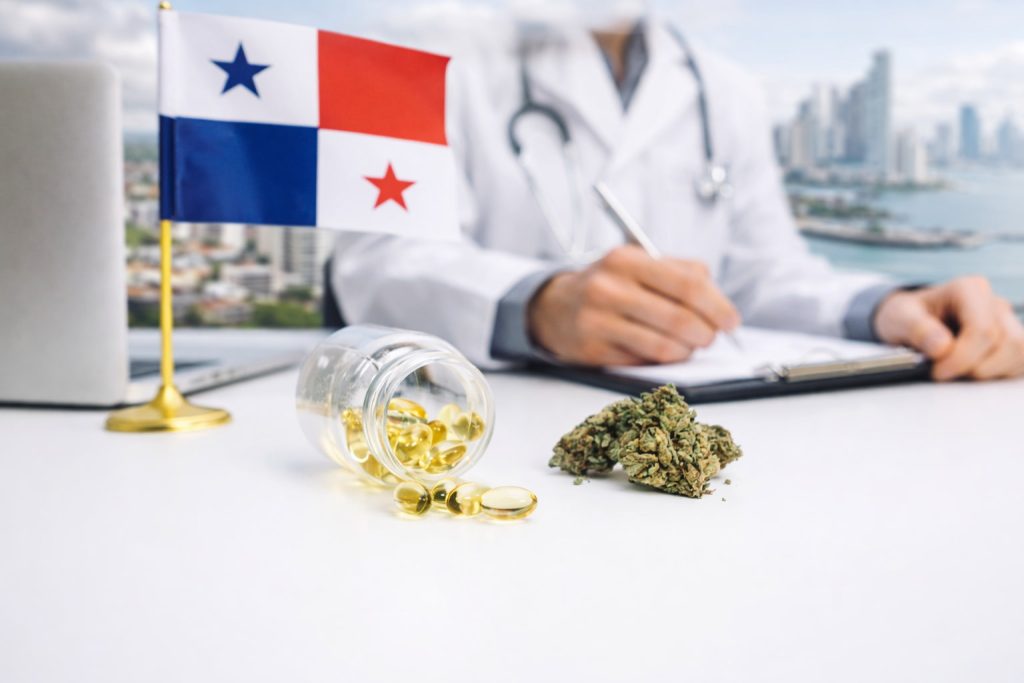
Panama is now home to its first pharmacy dedicated exclusively to medical cannabis products, marking a concrete step in the country’s rollout of regulated cannabis-based medication. Health authorities have emphasized that this is not a free-for-all retail product. Access is tied to medical criteria, prescriptions, and product controls.
How access works: CBD vs THC, and why it matters
According to the Ministry of Health (MINSA), medical cannabis products are being handled under a controlled framework. In public comments, MINSA officials have drawn a clear line between cannabidiol (CBD) products and products containing tetrahydrocannabinol (THC), which is treated more like a controlled medication.
- CBD products (non-controlled in the initial phase): MINSA has said that, at least in the first stage, certain CBD products with therapeutic activity may be sold through authorized channels without a prescription.
- THC-containing products (controlled): These require a special prescription process similar to other controlled medications and are expected to be reserved for more complex conditions under medical supervision.
To reduce confusion and improve transparency, MINSA has also pointed to a public information channel where patients and clinicians can verify which products are authorized and where they are available.
Is this important for Panama?
Yes, mainly because it shifts medical cannabis from informal access or overseas sourcing into a regulated healthcare setting. For many patients, that can mean more predictable product standards, clearer medical guidance, and better oversight on dosage and contraindications.
There is also a broader policy signal: Panama is building regulatory capacity for a category of medication that many countries struggled to integrate cleanly at first. The government has already issued seven licenses for commercialization, and officials have indicated that a specialized pharmacy is only one of several possible distribution models.
Potential benefits for Panamanians
If implemented carefully, the likely upside is concentrated in three areas:
- Patient relief and treatment options: Medical cannabis is typically framed as an additional option, especially when conventional treatments do not work well for certain patients.
- Trust through regulation: Product authorization lists, batch tracking, and formal dispensing can help reduce the risks associated with mislabeled or inconsistent products.
- Economic spillovers over time: For now, products are imported, but Panama’s framework includes a transition window that could lead to local cultivation or manufacturing under regulation, potentially creating specialized jobs and new compliance-intensive businesses.
Lessons from the United States: what to copy, what to avoid
The U.S. experience shows a mixed record that is useful to study.
What looks positive
- Tax revenue can be meaningful, especially in early years of market development. Colorado reports billions in cumulative marijuana tax and fee revenue since 2014. (cdor.colorado.gov)
- Regulation can replace unregulated access in some segments, especially when products are tested, labeled, and sold through licensed operators.
What raises caution flags
- Impaired driving risks remain a consistent public health concern, and U.S. health agencies continue to warn against driving after cannabis use. (CDC)
- Youth exposure and accidental ingestion, especially via edibles, has been a recurring issue in the U.S., even in places with rules designed to prevent it. (National Institute on Drug Abuse)
- A legal market does not automatically eliminate illicit sales, and enforcement capacity matters. (Congress.gov)
The key difference is that Panama is starting with a medical-first model with tighter controls than many adult-use markets. If Panama stays disciplined about prescriptions, advertising limits, packaging standards, and enforcement against diversion, it can capture patient benefits while reducing the downsides seen in more commercialized environments.
What this changes for expats already using medical cannabis
For expats who rely on regulated medical cannabis, the arrival of an authorized supply channel can reduce uncertainty and make Panama more practical as a place to live part-time or full-time, especially for those managing chronic conditions. It also creates a clearer pathway for discussing treatment with local physicians instead of relying on informal solutions.
This topic may be especially relevant in areas with larger international populations such as Boquete and Panama City.
Bottom line
This is a meaningful development for Panama, but its long-term impact depends less on headlines and more on execution: physician education, transparent product controls, enforcement against misuse, and a public health approach that stays focused on patients rather than hype.If you are planning a move to Panama and want help choosing the right community and navigating the housing search, Casa Solution can help you make a smooth transition.
Date written: January 25, 2026