


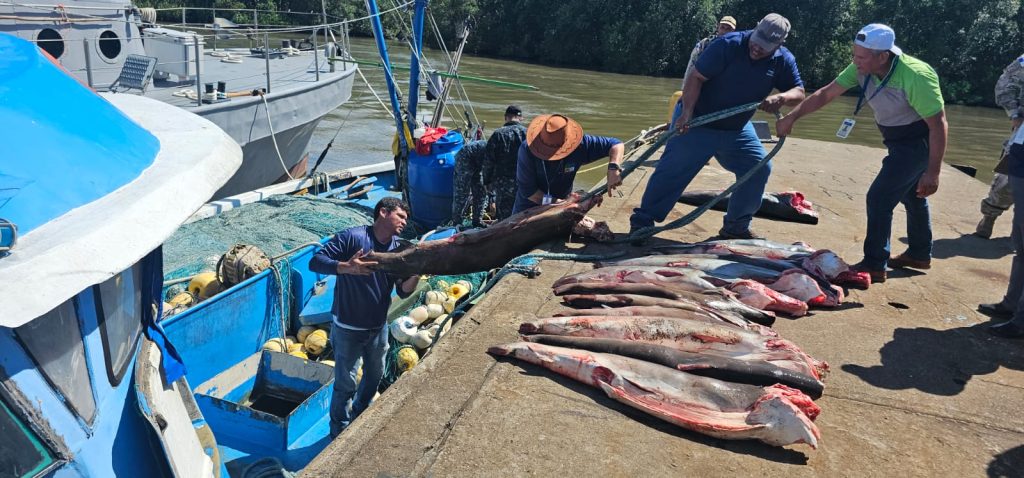
Panama’s Ministry of Environment (MiAmbiente) has established an indefinite zero quota for the commercial export of shark and ray species listed under CITES, effective January 1, 2026. The measure blocks international commercial exports of these species, including products, subproducts, parts, and derivatives. MiAmbiente says the goal is to prevent overexploitation while the country strengthens scientific data, population monitoring, and systems for traceability and enforcement. (MiAmbiente – Ministerio de Ambiente)
What the new rule does (and does not do)
Under the policy, commercial exports covered by CITES listings are prohibited indefinitely. MiAmbiente indicated the restriction will remain until Panama develops species-by-species scientific research, implements population monitoring, and consolidates effective traceability and control over specimens and related transactions.
MiAmbiente also noted limited exceptions for non-commercial purposes such as scientific, medical, educational, and certain law-enforcement or forensic needs, which still require formal authorization processes.
Why sharks matter in the ocean food web
Sharks are not just another catch category. Many species function as top or high-level predators that help regulate marine food webs. When shark populations decline, ecosystems can become less stable, sometimes triggering cascading effects that change the abundance and behavior of other species and alter how reefs and other habitats function.
Research also emphasizes that sharks can influence ecosystems in more than one way, including predation, competition, and nutrient movement across habitats. Those roles can be difficult to replace once populations are depleted.
Trasmallo season, local concerns, and why enforcement matters
Along parts of Panama’s Pacific coast, fishing activity intensifies during certain seasons, including the use of trasmallo (a trammel net system that uses layered netting designed to entangle fish of different sizes).
Beyond the export restriction itself, the bigger challenge is what happens on the water and at landing sites. Monitoring, reporting, and enforcement are what determine whether protections are real in practice.
Andres Padron, a broker at Casa Solution Real Estate who spends significant time in coastal areas, described seeing fishing boats during trasmallo season with large containers filled with whitetip sharks being landed on a frequent basis. That type of extraction, if persistent and unmanaged, can be disruptive because many shark species have life histories that make them less resilient to heavy fishing pressure.
MiAmbiente’s announcement directly acknowledges this enforcement gap by pointing to the need for improved science, population monitoring, and traceability systems. In other words, the export ban is positioned as a conservation step that buys time, not a complete solution by itself.
Where this is especially relevant for coastal Panama
Communities that depend on healthy marine ecosystems, whether for fishing, tourism, or everyday coastal life, tend to feel these changes first. For readers familiar with areas like Cambutal and Playa Venao, marine biodiversity is not an abstract concept, it is part of the local economy and lifestyle.
A practical takeaway
Policies like a zero export quota can reduce external commercial pressure, but lasting results typically require consistent on-the-ground capacity: dockside controls, verified reporting, targeted patrols during high-catch seasons, and traceability that can actually be audited.
If you live in a coastal area and witness repeated landings of protected species, the most constructive role residents can play is to support transparent reporting channels and accountability that strengthens legitimate, sustainable fishing while discouraging illegal or untracked extraction.
If you are planning a move to Panama and want grounded, on-the-ground inmmunities and day-to-day realities, Casa Solution Real Estate can help you compare areas and make informed decisions.
Written on January 25, 2026