


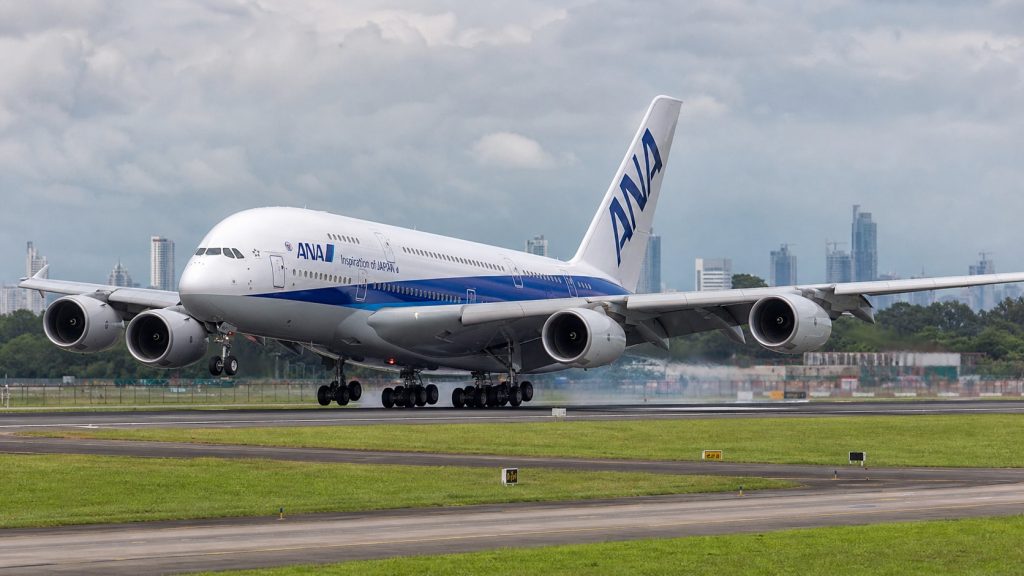
Panama and Japan are now looking at the technical side of a possible direct flight between Panama City and Tokyo, after executives from All Nippon Airways (ANA) and Boeing visited Tocumen International Airport to evaluate the route. The meeting included Panama’s Civil Aviation Authority, Tocumen airport officials, the Ministry of Foreign Affairs, Copa Airlines, ANA, and Boeing.
The idea did not appear out of nowhere. In September 2025, during a bilateral summit in Japan, President José Raúl Mulino and then Japanese Prime Minister Shigeru Ishiba discussed stronger economic cooperation, a labor exchange program, and progress toward a direct air connection between both countries.
Why This Route Matters
A Panama-Tokyo flight would be important because Panama is already one of Latin America’s strongest air connection points. According to Panama’s tourism authority, the country connects directly with 89 cities in the Americas and Europe across 36 countries. Tocumen is also described as the best-connected airport in Latin America, operating 24 hours a day, 365 days a year.
For Japan, the logic is clear. Panama offers access not only to Panama itself, but to Central America, South America, the Caribbean, and parts of the United States through Copa’s hub. A passenger from Tokyo could land in Panama and connect to Colombia, Costa Rica, Peru, Chile, Florida, the Dominican Republic, or other regional destinations without entering a larger, more congested North American airport.
That is the real opportunity. This is not just about Japanese tourists visiting Panama. It is about whether Panama can become a practical Asian gateway into Latin America.
The Critical Question – Is It Financially Viable?
This is where the story needs caution. A direct Panama-Tokyo flight would be very long, expensive, and operationally demanding. Panama City to Tokyo is roughly 13,500 kilometers, while Boeing lists the 787-9 range at about 14,010 kilometers. That means the route may be technically possible, but airlines also have to consider winds, cargo, passenger loads, fuel reserves, airport performance, and profitability.
ANA will not launch this route simply because it sounds good diplomatically. It would need enough high-yield passengers, consistent connecting demand, possible cargo revenue, strong cooperation with Copa, and efficient airport processing through systems like One Stop Security.
There is also a demand risk. Japanese outbound travel has still not fully recovered to pre-2019 levels. JTB Tourism Research reported that Japanese overseas travelers in February 2026 were still 28.8% below 2019 levels.
That does not make the route impossible. It just means Panama would need more than political enthusiasm. It would need coordinated tourism promotion, business travel demand, strong codeshare agreements, and a clear strategy to fill seats in both directions.
What This Could Mean for Panama
If the route becomes reality, the benefits could go beyond aviation. More Asian visitors, especially from Japan and potentially connecting markets such as China, Hong Kong, Taiwan, South Korea, and Southeast Asia, could help hotels, restaurants, tour operators, shopping areas, logistics firms, and professional services.
This is especially relevant because Panama already has a deep Chinese-Panamanian presence. The Chinese community has been part of Panama’s history for more than 150 years, including contributions to the railroad and the Canal. (AP News) Areas such as El Dorado, Panama City, and Tocumen could naturally benefit from stronger Asia-facing travel, whether through tourism, business visits, or longer-term relocation interest.
Possible Local Property and Business Effects
This should not be exaggerated. One direct flight will not transform the property market by itself. However, if the route succeeds and brings consistent Asian visitor flow, the first impact would likely be felt in Panama City hotels, furnished rentals, commercial spaces, restaurants, and airport-adjacent services near Tocumen.
Neighborhoods with international appeal, strong business access, and established Asian community ties could see modest long-term benefits. The larger effect would depend on frequency, ticket pricing, marketing, and whether travelers use Panama as a stopover or simply as a connection point.
A Positive Step, But Not a Done Deal
For now, this is a serious technical evaluation, not a confirmed launch. The fact that ANA and Boeing visited Tocumen is meaningful, but the airline still has to prove the numbers work.
If Panama can combine its hub network, tourism growth, business ties, and efficient transit systems, a Tokyo route could become one of the country’s most strategic aviation achievements. But the route has to stand on economics first, not headlines.
For buyers, investors, and residents watching Panama’s international growth, Casa Solution Real Estate can help you understand how infrastructure, tourism, and connectivity trends may affect different areas of the country.
Article written: May 3, 2026