


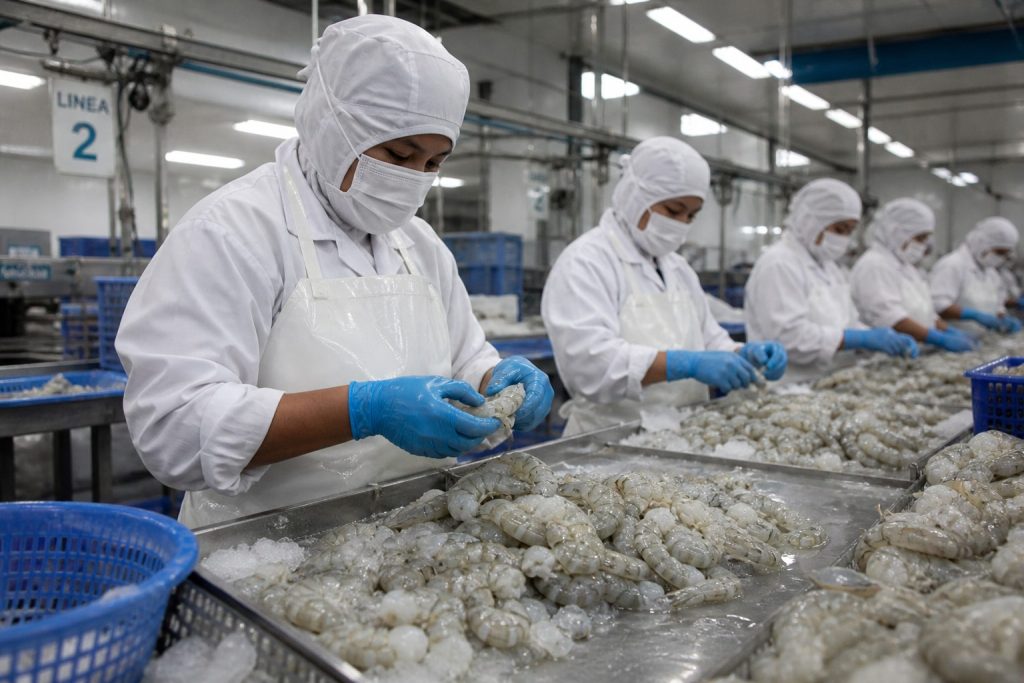
Panama’s goods exports reached B/.250.7 million through March 2026, the highest first-quarter level recorded between 2010 and 2026, according to the Ministry of Commerce and Industries, known as MICI, using data from INTELCOM and INEC.
The result was modest in growth terms, but important in context. Exports increased by B/.1.6 million compared with the same period in 2025, when the country recorded B/.249.1 million. That represents growth of around 0.6% to 0.7%, depending on the official calculation used in the MICI and INTELCOM reports.
While the increase is not dramatic, the record matters because Panama is better known internationally for services, logistics, banking, the Canal and air connectivity than for goods exports. A stronger first quarter suggests that the country’s export base is holding up, even as the mix of products and destination markets shifts.
Shrimp Leads Panama’s Export Basket
Frozen shrimp remained Panama’s leading export product during the first quarter. Other top export items included sugar, teak, watermelons, palm oil, scrap metal, medicines, bananas and yellowfin tuna. Together, the top 10 tariff categories represented 57% of registered goods exports.
The numbers also show a mixed picture by sector. Industrial exports led the period with 41% of the total and grew by 22.3%. Agroindustrial exports also performed strongly, rising 42.7% and accounting for 22% of the total. On the other hand, fishing and aquaculture declined by 8.6%, while agricultural exports fell by 39.8%.
That contrast is worth noting. The headline number is positive, but the gains were not evenly spread across the economy. Some export categories are expanding, while others faced a weaker start to the year.
Main Export Markets: United States, Taiwan and Colon Free Zone
The United States remained Panama’s top export destination, receiving 20% of registered exports. Taiwan followed with 12.8%, while the Colon Free Zone accounted for 9.3% and India represented 7.7%. The Netherlands moved into fifth place with 5.5%, followed by Costa Rica at 5.3%.
Mexico, Thailand, Switzerland and Colombia completed the top 10 export markets. Together, these destinations represented 71.1% of Panama’s registered goods exports during the quarter.
This distribution shows Panama’s commercial links across several regions, including North America, Asia, Europe and Latin America. It also reflects the importance of trade agreements and logistics networks in keeping Panamanian products connected to international buyers.
Value-Added Exports Add to the Total
When registered exports are combined with value-added exports from special regimes, Panama’s total exportable supply reached B/.330.3 million through March 2026. That was B/.5.8 million higher than the same period in 2025, when the total stood at B/.324.5 million.
Exports from special regimes, including free zones and the Panama Pacifico Special Economic Area, totaled B/.79.6 million and grew by 5.6%. This part of the report is significant because it points to more than raw production. It shows the role of processing, logistics, manufacturing and business platforms in adding value before products reach international markets.
For Panama, that is an important distinction. The country has long relied on its geographic position and service economy, but export growth linked to value-added activity can help diversify the broader economy.
The first-quarter result does not mean every sector is growing equally. Still, it gives Panama a positive trade indicator at the start of 2026, with stronger industrial and agroindustrial activity helping offset declines in other categories.
Article written on: May 3, 2026