

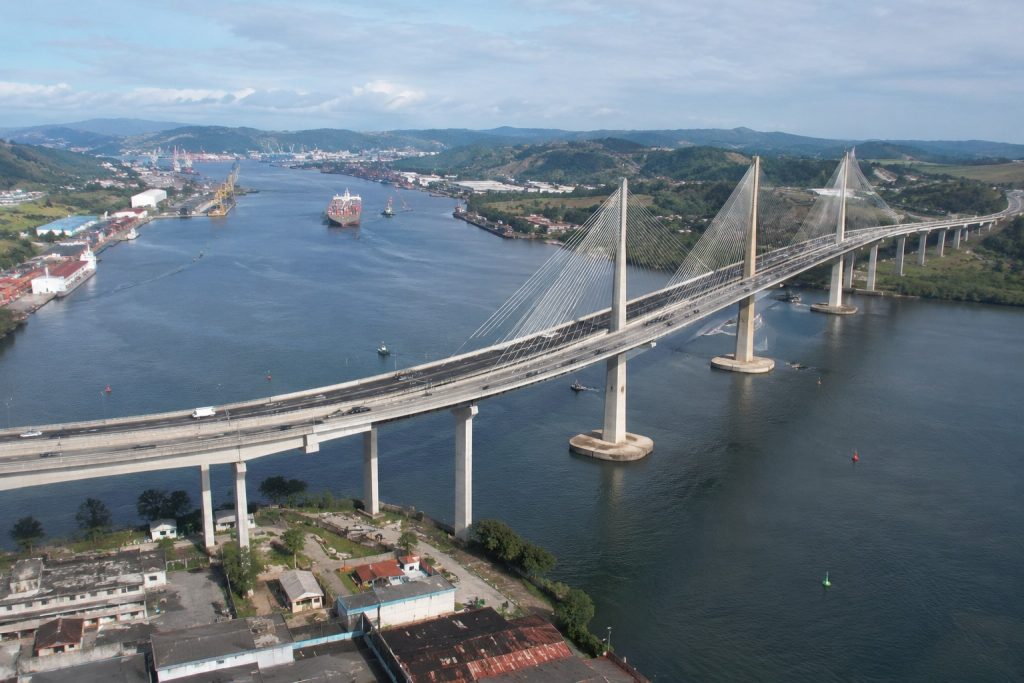
Panama’s Fourth Bridge over the Canal is now projected to cost $2.387 billion, including financing, after a new $295 million addendum was signed to redesign the project’s eastern interchange. The Ministry of Public Works says the change is meant to avoid future congestion and improve connections toward the Corredor Norte, Albrook, Avenida Omar Torrijos, and other key points in Panama City.
Why the Price Increased
According to Public Works Minister José Luis Andrade, traffic studies showed the previous design would have created a “grade F” traffic scenario – essentially, heavy congestion from the moment the bridge opened. The government says the redesign will create what may become the largest interchange in Panama and possibly Central America.
The project is currently around 35% complete and remains scheduled for delivery in December 2028, after more than four years of accumulated delays.
What Panama Is Getting for $2.387 Billion
The Fourth Bridge is planned as a 965-meter cable-stayed bridge with six traffic lanes, two major interchanges, and a 75-meter navigation clearance to allow neopanamax ships to pass through the Canal. Its main purpose is to ease the daily bottleneck between Panama City and Panama Oeste.
How the Cost Compares Internationally
| Bridge | Country | Reported Cost | Quick Comparison |
|---|---|---|---|
| Fourth Bridge over the Canal | Panama | $2.387 billion | Panama’s new projected total |
| Golden Gate Bridge | United States | $35 million in the 1930s, about $1.5 billion in 2016 dollars | Panama’s bridge is costlier than the inflation-adjusted Golden Gate estimate reported by the bridge district (Golden Gate) |
| Queensferry Crossing | Scotland | £1.35 billion | Similar scale of modern public infrastructure spending (Institution of Civil Engineers (ICE)) |
| 1915 Canakkale Bridge | Turkey | About €2.5 billion | Very close to Panama’s cost, but for a record-breaking suspension bridge (Asharq Al-Awsat) |
| Akashi Kaikyo Bridge | Japan | About $3.6 billion | More expensive, but also one of the world’s great suspension bridges (Wikipedia) |
| Hong Kong-Zhuhai-Macao Bridge | China | About $18.8 billion to $20 billion | Far more expensive, but it is a 55 km bridge-tunnel system (Wikipedia) |
| Sutong Yangtze River Bridge | China | About $1.7 billion | Less than Panama’s total, despite being an 8.2 km cable-stayed bridge (Wikipedia) |
| Russky Bridge | Russia | About $1.1 billion | Less than half Panama’s projected cost (The Moscow Times) |
The Real Question: Expensive or Just Complex?
The comparison is not perfect. Panama’s figure includes financing and major road interchanges, not just the bridge structure. That matters. Large urban access roads, ramps, land connections, utility work, environmental compliance, and traffic redesign can dramatically raise the final price.
Still, the number is significant. At $2.387 billion, the Fourth Bridge is now in the same cost conversation as some of the world’s most ambitious modern bridges. For a country Panama’s size, this is a massive public investment.
Why It Matters
The project is not just about building another bridge. It is about whether Panama can execute a large infrastructure project without more delays, redesigns, or cost increases. The new addendum may be justified if it prevents the bridge from opening into immediate congestion. But it also raises a fair question: why were these traffic problems not solved earlier?
If completed properly, the Fourth Bridge could become one of Panama’s most important infrastructure assets. If not, it risks becoming another example of how poor planning can make public works far more expensive than expected.
Article written on May 9, 2026.