

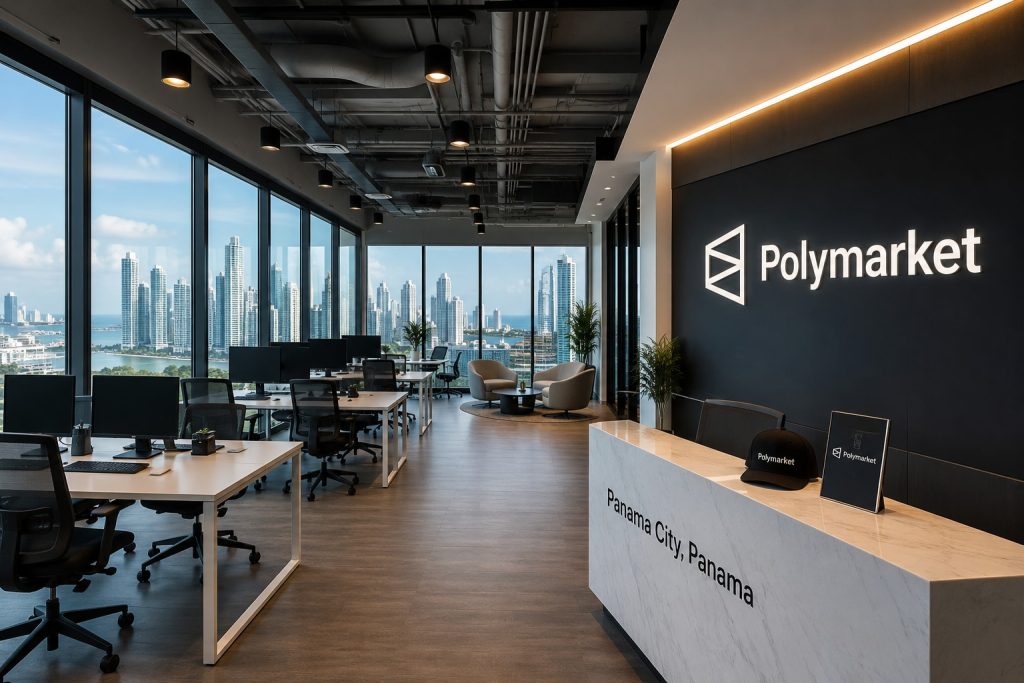
A little-known office address in Punta Pacífica has suddenly become linked to one of the largest and fastest-growing prediction betting platforms in the world.
Polymarket, the cryptocurrency-based prediction market valued at an estimated $15 billion, officially lists Panama as part of its legal and operational structure after facing regulatory pressure in the United States. The company moved offshore following a 2022 settlement with U.S. regulators over operating without proper licensing.
Now, as billions of dollars flow through prediction markets every month, Panama has become part of a much larger international debate involving crypto regulation, gambling, financial transparency, and the future of online betting platforms.
According to an investigation by NPR and La Prensa, journalists visited the company’s registered address in Panama – the 21st floor of Oceanía Business Plaza in Punta Pacífica. Instead of finding an active Polymarket office, they found the law firm García de Paredes Abogados operating there.
The same office reportedly hosts legal addresses for at least 15 other crypto-related companies, including firms tied to prediction markets and decentralized finance platforms.
A Massive Industry Growing at Full Speed
Prediction markets have exploded in popularity during Donald Trump’s second term in office.
In April alone, Polymarket reportedly processed more than $8 billion in trading volume, up dramatically from under $1 billion during the same period the previous year. Combined with competitor Kalshi, the sector surpassed $24 billion in monthly activity.
Users place bets on everything from elections and geopolitical conflicts to the future of world leaders and economic events. Some of these activities remain illegal or heavily restricted in the United States.
That is part of the reason Panama entered the picture.
Panama offers offshore corporations several advantages, especially for companies operating internationally. Firms structured correctly can avoid local taxes on foreign-generated income and may gain additional legal protections against foreign court rulings.
Bruce Zagaris, a Washington-based attorney specializing in international criminal law, told reporters that Panama’s regulatory structure offers “many advantages” from both a fiscal and legal perspective.
But there is another side to the story.
Offshore Structures Bring Attention Too
We looked into Polymarket’s presence in Panama, obtained its government paperwork and visited its headquarters in Panama City.
There was no sign of Polymarket. Nobody had heard of Polymarket there.
After more digging, we found that more than a dozen other crypto companies…
— Bobby Allyn (@BobbyAllyn) May 5, 2026
Panama has spent years trying to improve its international financial image after repeated scrutiny over offshore structures and transparency concerns. The arrival of large crypto-related entities may create economic opportunities, but it also raises questions about oversight and compliance.
The article notes that Polymarket’s Panama structure appears designed to keep controversial betting activity outside direct U.S. jurisdiction. However, experts warn that offshore platforms still need strong compliance systems, especially regarding customer verification and suspicious activity monitoring.
“What today is tolerated may not be tolerated tomorrow,” Zagaris warned in the report.
That may be the key issue here.
Prediction markets are growing faster than regulators can keep up. While crypto enthusiasts see these platforms as innovative financial tools, critics argue they can become vehicles for regulatory arbitrage, insider trading risks, and gambling disguised as financial speculation.
The platform itself officially prohibits users from bypassing restrictions through VPNs. However, recent investigations suggest enforcement may not be foolproof.
One case mentioned involved a U.S. Army sergeant accused of using insider information tied to an operation involving Venezuelan President Nicolás Maduro. Prosecutors allege he used a VPN to place large bets on political outcomes and earned more than $400,000.
Panama Becoming a Crypto Jurisdiction?
This story also reflects a broader trend.
As global regulators tighten rules around crypto, betting, and financial technology, companies continue searching for jurisdictions that offer flexibility, lower taxes, and legal distance from major regulators.
Panama has increasingly appeared on that list alongside places like Dubai, the Bahamas, and certain U.S. states such as Delaware.
Areas like Punta Pacífica Real Estate and nearby financial districts such as Bella Vista Real Estate continue attracting international companies, legal firms, fintech operators, and crypto entrepreneurs looking for global connectivity and corporate flexibility.
Still, the long-term question is whether Panama wants to become known primarily as a refuge for offshore crypto operations – or whether it can position itself as a properly regulated fintech and digital finance hub with credible oversight.
That distinction matters.
If Panama wants to attract serious long-term international business in emerging sectors like crypto and fintech, many analysts believe the country will eventually need stronger transparency standards, clearer regulation, and better enforcement mechanisms. Otherwise, the same advantages attracting companies today could later generate reputational pressure from foreign governments and regulators.
For now, however, the money flowing through platforms like Polymarket is impossible to ignore.
And Panama has once again found itself sitting quietly in the middle of a rapidly growing global financial story.
Looking to better understand Panama’s evolving business landscape, investment climate, and communities? Casa Solution Real Estate continues to help expats, investors, and buyers navigate opportunities across Panama.
Article written: May 9, 2026